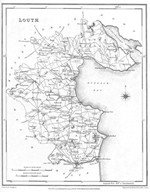
Where in Ireland are your Boylan roots?

Thursday, May 17, 2007

Paddy's Lament - Worth the Read!


Last week I picked up Paddy's Lament by Thomas Gallagher. Its billed as "The 'shocking, powerful' account of the great famine and the Irish diaspora to America - an invaluable history that illuminates the continuing troubles." Written in 1987, it really lives up to its billing. It is the single best book I have found explaining all aspects of famine life in such a compelling way. I have a hard time putting it down at night. Try reading his chapter's about the coffin ships without experiencing the stench and claustrophobia for yourself. If you have ancestors who lived through the famine this book will add so much context to the story the genealogical records only hint at. I can't recommend it highly enough.

Wednesday, May 16, 2007

My Upcoming Irish Adventure

In exactly one month I will be back in Ireland - I can't wait. I will be spending a couple of days exploring Dromin from my home base in Ardee. I hope to go to mass at the local church, St. Finian's, and explore its graveyard. I hired a researcher to pinpoint the land my ancestor rented in Dromin at the time of the famine so, hopefully, I will be able to find that plot. Somewhere near the church there is a well where emigrants would go to wish for a safe return to Ireland that I also hope to visit. If all goes as planned it should be both informative and reflective.

I'm hoping the graveyard yields some clues to family mysteries pre-1800 and allows me to move my family tree back one more generation. We shall see.

Right after Dromin we will be driving through Cavan (where my DNA test seems to show my ancestors might have moved from). My two Boylan genetic "cousins" are from Kilnaleck. As luck would have it, there is a Boylan Pub in this village so I plan to stop and have a pint. It's supposedly still owned by Boylan's though I doubt I'll be so "American" as to tell them we could be related...but you never know!

I'm hoping to do some blogging from Ireland so you should be able to follow my trip and any new discoveries here.

Sunday, May 13, 2007

St. Finian's of Dromin


The parish church in Dromin, Louth (where I assume my ancestors once worshipped) has a great web site that has pictures of the interior of the church, as well as historical background. Check it out: http://dunleerparish.ie/StFiniansChurch.htm

Friday, May 11, 2007

Graves Can Say the Darndest Things...

Sometimes it's easy to forget what the life of a famine immigrant must have been like. While searching for my g-g-g grandfather George Boylen's birthplace in Ireland I found the graves of his two sisters in Mount Calvary in Boston, MA. One grave answered my question of where my family came from: Louth. The other grave gave me a reason to reflect. It reads:

Mary Boylen, Died August 8, 1892, Aged 57 years. This stone is erected in her memory by her loving mistress, Mary E. Holmes, in whose household she was a blessing for 27 years. Well done thou good and faithful servant. Enter thou into the joy of the Lord.

Even in her death she was still a servant taking orders from her mistress! Mary was a maid in a very tony home on Chestnut Street on Boston's Beacon Hill. I'm sure this stone was a way of showing affection for Mary but its amazing how it looks in the hindsight of history. (Double click on the photo to read the inscription for yourself.)

Thursday, May 10, 2007

Sandbanks Cemetery

Sandbanks Cemetery, otherwise known as Auburn Catholic Cemetery, in Watertown, MA is in sinful condition. To make matters worse, it is owned by the Roman Catholic Archdiocese of Boston.

According to the work of Mary Daly, who transcribed every tombstone with an Irish place name for her book Gravestone Inscriptions of Mount Auburn Catholic Cemetery, Watertown, Mass, this cemetery accepted new graves from 1850 until 1882. The stones here have Irish last names and most of these were Irish immigrants who escaped the famine only to endure harsh living conditions in Boston. These were the immigrants whose very, very hard earned dollars built the Catholic Church in Boston. Walking around here looking for my g-g-g grandparents stone sickened me.

The cemetery has been largely abandoned by the Archdiocese for decades. Stones have turned over and have sunken into the dirt. Trees and brush have covered many of the stones at the edge of the cemetery. In my opinion, this says so much about the Catholic Church - once you can't donate they forget you - even if they offered you perpetual care.

Many of my Boylen ancestors were buried here. From what I can tell searching this lost graveyard, only one of my family tombstones survived. As you can probably tell I have a love/hate relationship with the Catholic Church. The experience of seeing this abandoned cemetery only reinforced my anger. Shameful.

Wednesday, May 9, 2007

DNA: Boylan or McMahon?

So what do we know about the Ancient Boylan clan? We know that a Fourteenth Century poet commented on their horsemanship, we know they came from Flanagan stock, we know their blue eyes were famous, and we know they warred with the McMahons who eventually shrunk the Boylan territory.

I had my Y chromosone tested a year and a half ago when I still couldn't locate my family's last place of residence in Ireland. I hoped it might link me to other Boylan's and, therefore, yield some clues - up until very recently it hadn't helped much. But in the last two weeks I had reasonably close genetic matches to other Boylan's from an area of southern County Cavan (only about 25 miles from Dromin).

But what I find even more surprising is a probable genetic link to the McMahon clan who warred in ancient times with the Boylan's. Whenever I used to see these clan tales in heraldry books I would consider them fables. However, now that I (and I assume my other 2 genetic Boylan "cousins") have shown a strong link (albeit roughly 1000 years ago) to the McMahon clan I am left wondering how many of these stories passed from generation to generation may be true. I am told that in ancient Ireland clans would "foster" the children of their enemies killed in battle. Was this a case of fostering? And if it was who "fostered" who? I guess only time will tell as more Boylan's and McMahon's get genealogical DNA tests. Its amazing what DNA can show!

Oh, and by the way, I don't see any ties yet to the Flanagans!